Posted on
More from News


Networks are expanding all the time. Even the smallest digital businesses are finding themselves having to look ahead and consider their future cabling needs, preparing accordingly.
As a result, storing a supply of cabling is sometimes an inevitability. But there is a right and wrong way of ensuring excess products are stored in a manner that does not compromise performance when they are eventually used.
Indoor cabling
Whether they are made from copper or optical fibre, indoor cabling always needs to be protected from the elements. Not only are they not waterproof, but they often come in a jacket that is not UV resistant.
It is, therefore, a bad idea to store indoor cabling outside or in any other harsh environment as this can have a catastrophic impact on speed and performance capabilities.
Indoor cables should subsequently always be stored somewhere dry and protected from UV light, whether that be in a room or a container.
While airtight containers can be useful, placing them outside is still a risk as it may be exposed to moisture from condensation, which in turn can have the same corrosive effect.
When moisture comes into contact with the make-up of a cable, it affects both its short-term and long-term electrical performance, and could even lead to it failing the criteria needed for category performance.
Temperature is another consideration, so always carefully examine the specifications that come with your cables and ensure they are met.
It all means that the choice of storage location is key. Consider a site that is not at risk of excess humidity, heat or at risk of chemical spills and is safe from extreme weather such as flooding.
Outdoor cabling storage
While outdoor cabling is designed to resist harsh conditions, it does not mean users can be careless when placing it in storage.
Much like indoor cables, they still need to be protected from physical damage and should never be exposed to an environment where they are stressed beyond their prescribed parameters.
Similarly, although designed to provide high-quality performance in even the toughest conditions, there are still optimal temperatures for storage that need to be observed.
All cables placed in storage are potentially still vulnerable to the elements, even if they are created for outdoor use. To ensure they are protected, it is, therefore, essential that the ends are sealed, ideally through heat shrunk cable end caps. This point is especially important when storing optical fibre for four weeks or more.
Indoor and outdoor
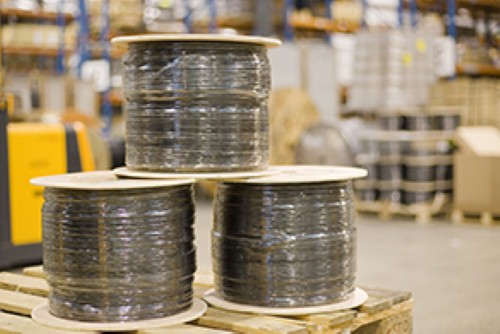
If storing optical fibre, whether indoor or outdoor, always ensure the reel is stored upright. If stored on its side, it can cause cable layers to shift, which in turn can lead to them snagging when de-reeling, which in turn can leave them at risk of damage.
Whenever reels come with a protective coating, it should remain in place until the cable is ready to be installed.
There may be occasions, such as inspections, where removing the protective layer is necessary. It is therefore important in such cases to ensure it is fitted as originally supplied before it is placed back into storage.