Posted by News round-up on
More from News


There have been a number of exciting and interesting developments in the cabling industry, which are set to have a substantial impact on consumers and businesses alike.
Copper is superfast
The middle of July saw a team of researchers at Bell Labs announce that traditional copper phone lines carry the potential of delivering an ultra-fast connection comparable to that of broadband.
The team claims to have used the technology to transfer data a record speed of 10Gbps, having conducted tests with two pairs of 30 metre lines.
They claim the breakthrough would not only solve the problem of slow internet speeds, but would also cut costs for cities or locations where the laying down of fibre optic cables is not possible.
In a press release, Bell Labs said: "Achieving 1 Gbps 'symmetrical' services – where bandwidth can be split to provide simultaneous upload and download speeds of 1 Gbps – is a major breakthrough for copper broadband.
"Fibre can be brought to the curbside, wall or basement of a building and the existing copper network used for the final few metres."
However, some experts have still expressed doubts over the capabilities of such technology.
Chris Green, a technology analyst at the Davies Murphy Group consultancy, told the BBC that copper phone lines would not be a foolproof solution for solving slow internet speeds, as rural properties miles away from telephone exchanges would still need fibre optic cables rather than copper lines in order to achieve 1 Gbps speeds or more.
BT to commence undersea project in western Scotland
Meanwhile, BT has announced that it has started work on a project to lay undersea fibre cables on the west coast of Scotland.
It comes as part of ongoing efforts to bring superfast broadband to some of the country’s most remote island communities.
The £146 million Highlands and Islands project is being led by Highlands and Islands Enterprise (HIE) and will link communities through the delivery of around 400 km cables.
The first parts of the project have already been completed with subsea cables deployed in Largs, Cumbrae, Cowal, Mull, Oban, Ardgour and Corran.
Optical Fibres could disappear into thin air
BT's efforts may soon prove to be in vain if research at the University of Maryland is to be believed.
Professor Howard Milchberg has claimed that the power of optical fibres could be extended to any point on Earth, or even in space, by way of an 'air waveguide', which could use light signals collected from distant sources to transfer data. The technology could change the face of long-distance communication.
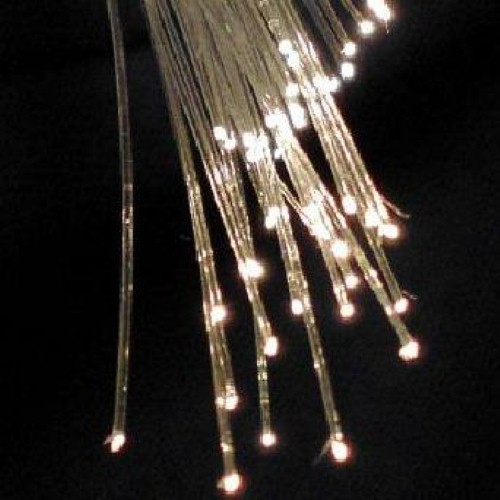
Fibre optical cables have become a hugely popular tool when it comes to connectivity, working by trapping light beams to guide them like a pipe, preventing any loss of intensity or focus.
Most fibre optic cables are made up of a transparent glass core surrounded by a cladding material that has a lower index of refraction, meaning that when light attempts to leave the core it is reflected back inwards.
However, optical fibres are only capable of handling a certain amount of power and also need physical support, which may not be possible in certain areas.
As a result, Professor Milchberg and his team claim to have found a way to make air behave in the same way as an optical fibre, eliminating any loss loss of power over long distances.